Hyperbound vs Luster: Which AI Sales Roleplay Platform Fits Your Enablement Approach?

Your SDR team crushed their cold calling practice sessions last week. Monday morning, they dial into real prospects and stumble through the same objections they supposedly mastered. Different pressure, different results.
Hyperbound and Luster attack this problem from opposite directions.
Hyperbound says practice more realistically, with AI buyers built from your ICP in under two minutes and scoring that mirrors your Gong scorecards.
Luster says to predict gaps before they happen, using AI to flag which reps will struggle with which conversations before customer calls.
This comparison breaks down where each platform excels, where they fall short, and what to consider if your practice needs span beyond prospecting or predictive analytics alone.
Hyperbound vs Luster At A Glance
Hyperbound is a voice-based AI coaching platform that converts ICP descriptions into interactive AI buyers in under two minutes. The platform integrates with Gong to score both practice sessions and real customer conversations against custom sales methodologies.
Luster is a predictive enablement platform that identifies conversation gaps before they impact revenue. The platform generates roleplay scenarios in approximately 90 seconds and includes screen-sharing for demo rehearsal.
Decision Criteria
Choose Hyperbound if:
SDR and AE teams need specialized cold calling and prospecting practice at scale
Gong integration matters for scoring practice alongside real customer conversations
Rapid ICP-to-AI conversion in under two minutes fits your scenario creation requirements
Voice-only practice covers your primary use cases without demo or presentation needs
Choose Luster if:
Predicting which reps will struggle before customer calls drives your enablement strategy
Screen-sharing for demo rehearsal addresses your presentation practice requirements
Personalized coaching plans based on calendar and performance data fit your approach
SMB or mid-market team size matches Luster's target deployment profile
Choose Exec if:
Practice requirements span prospecting, demos, renewals, and manager conversations
Custom scenarios need to deploy in 90 seconds without integration dependencies
Screen-shared demo practice with AI evaluation of both conversation and presentation matters
Revenue-wide certification programs need consistent standards across functions
Hyperbound vs Luster vs Exec Feature Comparison
Item | Exec | Hyperbound | Luster AI |
G2 Score | |||
Scenario Creation | Prompt-based, minutes | ICP/bot-based, fast | Data-driven, configured from gaps |
Voice Practice | Yes, stress-response learning | Yes | Yes |
Screen Sharing | Yes, dual analysis for demo practice and conversation competency | No | No |
Deployment Speed | ~ 90 seconds | Fast | Moderate |
Best For | Broad revenue conversations + demos | SDR/AE outbound and discovery | GTM teams wanting predictive coaching |
Starting Price | Custom enterprise | Custom per seat | Custom enterprise |
Hyperbound: Review
Platform Overview
Hyperbound is an AI sales training platform built around realistic call roleplays for prospecting and early‑stage conversations.
It turns ICP descriptions into AI buyer bots in minutes, then lets reps practice cold calls, gatekeeper calls, discovery calls, and follow‑ups in a safe, no‑risk environment.
A simulated autodialer and prebuilt scenarios recreate real call blocks so reps can handle objections, refine messaging, and build confidence before talking to live prospects.
Managers get call scoring and analytics to see who is improving and where to focus coaching
Platform Features
Rapid ICP-to-AI Conversion
Transforms ICP descriptions into interactive AI buyers in under two minutes. Sales enablement teams respond to new market segments or competitive positioning without waiting for content development cycles.
Voice-Based Prospecting Simulations
AI buyers present industry-specific objections and adapt based on how reps handle the conversation. Reps practice cold calls, discovery, and early-stage qualification in realistic voice interactions.
Gong Integration for Unified Scoring
Scores both practice sessions and real customer conversations against the same methodology rubrics. Enablement leaders see whether practice performance translates to actual call quality.
Custom Methodology Scorecards
Supports MEDDIC, Challenger, Sandler, and custom frameworks. Reps receive feedback aligned to organizational standards rather than generic conversation quality metrics.
Pros
Accelerates SDR onboarding through unlimited practice before real prospect calls
Integrates with Gong for personalized AI scenarios based on actual performance
Delivers AI-powered coaching feedback without manager time investment requirements
Creates customizable ICP-specific scenarios in under two minutes
Cons
Primarily optimized for cold calling and early-stage prospecting scenarios
No screen-sharing capability restricts practice to voice-only scenarios
Requires call recording integration and data access for implementation
Luster: Review
Platform Overview
Luster is a predictive enablement platform for go‑to‑market teams that uses AI to diagnose, predict, and prescribe training before skill gaps impact revenue.
It analyzes real call data and performance signals to pinpoint where each seller struggles, then builds hyper‑realistic simulations and targeted skill drills tailored to that person.
Reps practice upcoming scenarios in a safe environment, while leaders get dashboards showing proficiency, risk, and ROI on training. The result is more focused coaching, faster ramp, and fewer surprises on live calls.
Platform Features
Predictive Gap Identification
Uses call and performance data to identify skill and behavioral gaps before they appear in results. Enablement teams can target practice and coaching to high‑risk areas rather than discovering problems only after deals are lost.
AI‑Driven Practice Environment
Generates simulations and skill drills from existing enablement content, call insights, and playbooks, so reps can practice relevant scenarios without having to build everything from scratch. Timelines are faster than traditional content development.
Support for Demo and Call Rehearsal
Allows reps to rehearse important customer conversations, including call‑style interactions and demo‑like sessions where they can share their screen. Feedback focuses mainly on how they run the conversation, handle questions, and follow the desired structure.
Personalized Coaching Plans
Creates individual improvement pathways based on performance gaps, practice session data, and upcoming calendar commitments. Reps receive targeted practice recommendations rather than generic assignments.
Pros
Predictive analytics that surface skill gaps early and help prioritize where to coach.
Personalized simulations and drills that match each rep’s current strengths and weaknesses.
Automated guidance that reduces some of the manual load on managers and enablement leaders.
Cons
Focused mainly on GTM and sales use cases, so less relevant for non‑customer‑facing roles.
Depends on having usable call and CRM data, which can add setup work for teams earlier in their data journey.
Public information on specific integrations and technical requirements is limited
How Exec Delivers What Hyperbound and Luster Cannot
Hyperbound excels at voice-based prospecting practice with Gong integration for consistent scoring. Luster predicts conversation gaps before they surface on real calls. Both platforms solve specific problems well.
Neither addresses what happens when practice needs extend beyond outbound calls or predictive analytics.
Covers Demos, Renewals, and Leadership Conversations
Exec handles high-stakes conversations across the entire revenue organization: discovery, pricing, renewals, escalations, QBRs, internal leadership updates, and product demos. Luster focuses on predictive coaching from call data. Hyperbound concentrates on outbound and early-stage calls.
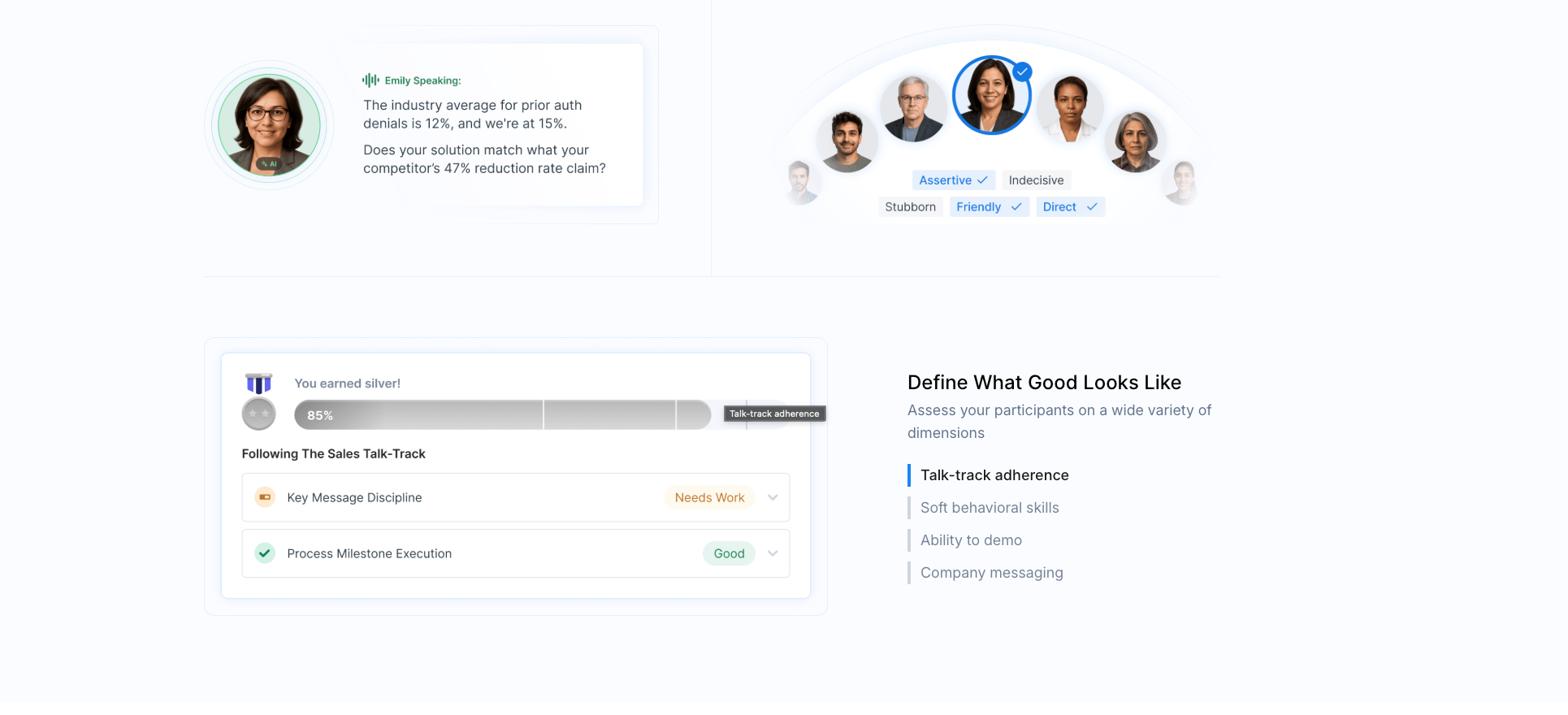
Exec provides one place to rehearse the interactions that actually drive revenue and alignment across teams. Not just SDRs and AEs, but also customer success, support, and managers.
Built for Demo and Screen-Sharing Practice
Exec lets sellers and SEs share their screen and run full product demos or slide decks during AI roleplays, with feedback on both what they say and how they present. That matters when deals hinge on navigating complex workflows, answering technical questions in real time, and adapting the story in real time.

Luster and Hyperbound excel in call-style simulations and skill drills but are not focused on end-to-end demo practice with live screen sharing. Exec closes that gap.
Rapid Scenario Creation Without Data Dependencies
Exec turns a plain-language description into a working roleplay scenario in minutes. Enablement responds same-day to new objections, pricing changes, or competitor moves.

Luster's predictive engine shines once calls and CRM data are flowing. Hyperbound's buyer bots anchor in ICP definitions and call outcomes. Exec doesn't require large historical datasets to start. Teams practice immediately and plug in content or data later as programs mature.
Stress-Realistic Practice Beyond Outbound
Exec's voice-based simulations feel like live, high-pressure conversations across many contexts, not only outbound. Reps, CS, and managers practice under conditions that resemble real meetings: layered objections, shifting stakeholders, and time pressure.
Hyperbound does this well for cold and discovery calls. Luster does it for situations its predictive engine surfaces. Exec extends stress-realistic training to the rest of the revenue lifecycle: demos, renewals, and internal leadership communication.
Stop Practicing on Your Customers
Luster predicts coaching needs from call data. Hyperbound drills outbound motions with AI buyer bots. Both reduce the odds that your reps learn through failed customer conversations.
Exec takes that further. New objections and competitor moves become practice within minutes. Demo-grade screen sharing lets reps rehearse the exact workflows buyers will see.
Voice practice spans sales, success, and leadership, so the whole revenue team stops treating real conversations as a training ground.
For leaders who care most about readiness in conversations that move deals and keep customers, Exec provides a practice-first foundation.
Book a demo to see how this works with your team.

- Hyperbound vs Luster At A Glance
- Decision Criteria
- Hyperbound vs Luster vs Exec Feature Comparison
- Hyperbound: Review
- Platform Overview
- Platform Features
- Pros
- Cons
- Luster: Review
- Platform Overview
- Platform Features
- Pros
- Cons
- How Exec Delivers What Hyperbound and Luster Cannot
- Covers Demos, Renewals, and Leadership Conversations
- Built for Demo and Screen-Sharing Practice
- Rapid Scenario Creation Without Data Dependencies
- Stress-Realistic Practice Beyond Outbound
- Stop Practicing on Your Customers
Launch training programs that actually stick